
2024 Under 5 Child Mortality
Child deaths fell again in 2024, but revised estimates mean the starting point was higher than we thought
The UN has updated their child mortality figures (the 2026 release, covering data through 2024). The visualisation below shows this data, where each square represents ~10,000 deaths. The entire image represents a total of 4.9 million under five-deaths.
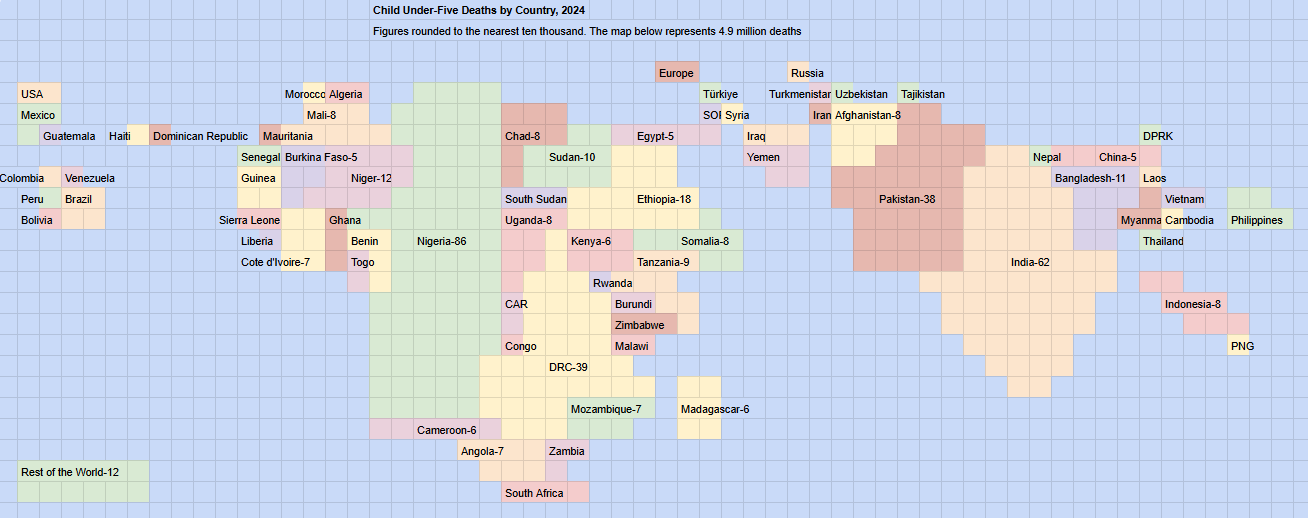
The biggest reductions from 2023 to 2024 are:
India – 35,000 fewer deaths
Ethiopia – 26,000
Pakistan – 11,000
China – 8,000
Türkiye – 5,000
Indonesia – 3,500
The only notable increases were in the Democratic Republic of the Congo (+2,200) and South Sudan (+1,200).
Some key points.
Under-five deaths have fallen 63% since 1990 and 52% since 2000
The annual decrease in deaths was:
2019 – 175,000
2020 – 31,000
2021 – 7,000
2022 – 237,000
2023 – 127,000
Progress stalled in 2020–2021 during COVID, but has since recovered
Sub-Saharan Africa accounts for 60% of all under-5 deaths
Just 6 countries (Nigeria, India, DRC, Pakistan, Ethiopia, Niger) account for half of all deaths
Countries classified as fragile or conflict affected account for over half of all under-five deaths
A note on data revisions
Comparing this year’s visualisation to last year’s, you’ll notice the map has actually gotten bigger, with an extra 209k deaths, despite real progress in 2024.
This year’s release incorporated the UN Population Division’s World Population Prospects 2024 revision, which revised sub-Saharan Africa’s population upward by 16 million (1.3%). More births mean more estimated deaths with the same mortality rates. The 2023 figure went from 4.78m to 4.99m (a 4.4% increase).
The biggest revisions were for Nigeria (+89k), DRC (+76k), Sudan (+21k), Ethiopia (+20k), and Uganda (+18k). A handful of countries were revised downward - Angola (-18k), Mali (-14k), and Indonesia (-10k)
The countries most affected are those with the weakest population data. Nigeria hasn't conducted a census since 2006; the DRC's last was in 1984. There are 23 countries where the most recent census is over 15 years old, meaning the Population Division is projecting forward from old baselines using fertility estimates from periodic household surveys and statistical models. I've written previously about the possibility that Nigeria's population is significantly overestimated, potentially by 50-70 million people. If that's even partially right, this revision could be moving the estimates further from reality rather than closer to it.